
Supervision for Teams in Nursing and Elderly Care in Berlin and Brandenburg
Be seen. Stay strong. Provide dignified care.
- Do you feel that your care team is doing a tremendous amount every day—and are you looking for ways to support them even better in this demanding work?
- Are there tensions in your team, a harsh tone, or a sense of silent exhaustion that is straining collaboration and the quality of care?
- As a manager or nursing supervisor, do you wish for more stability, cohesion, and motivation within the team, and are you wondering where to start?
Why is supervision important for nursing and elder care teams?
Nursing is one of the most demanding professions there is. Those who care for the elderly, the sick, or the dying encounter existential moments every day: pain, loss, and questions of dignity. This work requires physical stamina, emotional resilience, and perseverance – often under intense time pressure and with limited resources.
As a manager, HR representative, or nursing director, you are familiar with this reality. You know that your team performs extraordinary feats every day – and that the conditions of this profession make it difficult to remain consistently motivated, respectful, and resilient. When external appreciation is lacking, family members express mostly criticism, and those in care can barely express themselves, a feeling of invisibility can easily take hold within the team.
The consequences are well-known: a harsh tone creeps in and takes on a life of its own. Exhaustion that masquerades as indifference. Turnover that costs valuable skilled workers. And a leadership team that is itself under pressure and has little room to reflect on its own leadership practices.
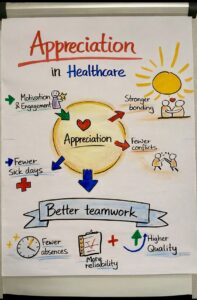
Common Topics in Supervision for Care Teams
Common topics that nursing and elder care teams bring to supervision include, for example:
- Emotional exhaustion and the feeling of being invisible
- A harsh tone within the team that has become ingrained
- Difficult dynamics with family members who complain instead of offering support
- Helplessness in the face of the suffering of those in their care
- Unclear roles and a lack of direction in the leadership structure
- Little room for grief, for mistakes, and for voicing what is difficult to say
How Supervision Supports Nursing Teams
Systemic team supervision for nursing teams creates a space where everything that is usually kept bottled up can be voiced. It enables teams to reflect on stressors, better understand team dynamics, and develop new perspectives.
Supervision is not a sign of weakness, but a sign of strong leadership – the conscious decision to invest in stability, collaboration, and quality within one’s own team.
In this process, I work with both care teams and managers and leaders, depending on what the situation requires.

Formats of Supervision
I offer supervision in various formats: team supervision, individual supervision, and case supervision.
Depending on the situation and your needs, we will decide together which format makes the most sense for your team or organization.
Conclusion
Anyone who holds a leadership role in caregiving knows that a stable and supportive team isn’t something that just happens on its own – it’s the result of deliberate investment. Supervision for care and eldercare teams in Berlin, Brandenburg, and online helps you achieve exactly that.
Here’s how supervision can specifically support your team:
- Identify, address, and effectively alleviate emotional exhaustion
- Strengthen self-esteem and team cohesion
- Consciously shape the tone of communication – making it more respectful, stable, and engaging
- Create space for grief, mistakes, and what would otherwise remain unspoken
- Develop a shared approach toward residents and their families
- Reflect on and clarify difficult dynamics with family members together
- Empower leaders – in their interactions with the team and with themselves
- Increase employee retention and reduce turnover in the long term
- Sustainably improve the quality of care through a more stable, motivated team
I support your team with a systemic perspective and deep appreciation for the work of caregivers – and with the goal of jointly creating a framework in which mutual respect can be rediscovered and lived out. Humor and optimism are always part of the process.
Supervision for Nursing and Elder Care Teams in Berlin and Brandenburg
1. What is supervision for nursing and elder care teams?
Supervision for nursing and elder care teams is a professionally facilitated space for reflection designed for nursing staff and managers. In team supervision, everyday situations in nursing care can be discussed, stressors addressed, and team dynamics better understood. The goal is to strengthen teamwork and ensure the long-term quality of care.
2. When is supervision beneficial for nursing teams?
Supervision is particularly helpful when nursing staff are under high emotional stress, tensions arise within the team, or the tone of communication becomes harsher. It provides a safe space to reflect on difficult situations together and develop new approaches to dealing with stress, conflicts, and responsibility.
3. For which care facilities is team supervision suitable?
Team supervision is beneficial in many care settings, such as nursing homes, home care services, senior care facilities, hospices, or geriatric wards. Supervision can provide valuable support wherever care staff face high emotional and organizational demands on a daily basis.
4. What topics do nursing and senior care teams frequently bring up in supervision?
Typical topics include emotional exhaustion, team conflicts, difficult dynamics with family members, uncertainties in dealing with suffering and dying, and tensions between staff and management. Questions regarding collaboration and attitudes in everyday nursing practice also frequently come up.
5. How does team supervision for nursing staff work?
In team supervision, the team works with the supervisor to reflect on specific situations from everyday nursing practice. Through structured discussions, systemic questions, and shifts in perspective, stressors are identified, team dynamics are understood, and new courses of action are developed.
6. What types of supervision are available for nursing facilities?
Supervision can take the form of team supervision for the entire nursing team, individual supervision for managers or nursing supervisors, or case supervision focused on specific care situations. A joint decision is made regarding which format is most helpful for the respective facility.
7. How can supervision relieve the burden on nursing staff?
Supervision creates a space where stressors can be voiced and reflected upon together. Nursing staff feel that their experiences are acknowledged and taken seriously. This helps reduce emotional tension, develop new perspectives, and strengthen personal resilience.
8. What are the benefits of supervision for the entire care team?
Team supervision strengthens team cohesion, improves communication, and helps resolve conflicts constructively. At the same time, it supports care staff in developing a shared approach to interacting with residents, patients, and their families.
9. Do you offer supervision for care teams only in Berlin and Brandenburg, or also online?
I primarily provide in-person support to nursing and elder care teams in Berlin and Brandenburg through team, individual, and case supervision. Supervision can take place on-site at the facility. Upon request, I also offer it online in small groups or for urgent conflicts that need to be resolved, particularly for management.
10. How often should supervision take place in nursing care?
Many care facilities work with regular supervision, for example every four to eight weeks. Depending on the need, supervision can also be provided as short-term support in stressful situations or as an ongoing process over a longer period of time. I typically work with my teams for two to three hours, depending on the need and team size. Together, we decide what is right for you and your team.
M. V., Manager and Dentist in a Dental Practice
Ms. Kostadinowa-Rohde very quickly succeeded in strengthening us as a management team in structured coaching sessions and her professional feedback helped us a lot in the further development of our management style, the structure in our practice and also in holding team meetings to discuss current issues in order to avoid new conflicts.
Dr. P. B., Lecturer and Head of Department at a Berlin University
With a great deal of commitment, classic and unconventional training methods, she was able to sensitize the colleagues in our workshop “Team building through feedback”. For teachers, receiving personal feedback in a group of colleagues is an unusual situation. With her professional moderation and a great deal of sensitivity, she mastered this excellently and led the workshop to a "tangible" result in the form of feedback rules that we developed together with her. The result will accompany the colleagues in the department in their future work.
Dr. M. B., Engineer/Managing Director of a Company in the Aviation Industry
With her background in mediation and coaching and her skills as an intercultural trainer, she was able to guide the German-English team through the workshops. In linguistically very difficult situations and in heated discussions, she was able to contribute significantly to the success of the workshops through simultaneous interpreting. Ms. Kostadinowa impressed and inspired my colleagues and me with her engaging, people-oriented manner, her humor and her strong personality.
G. V., Dental Practice Manager
Both the team and my partner and I have come to know and appreciate Ms. Kostadinowa-Rohde's warm-hearted manner, her humor and her structured leadership. She asks smart questions, picks up when things get very emotional, shows ways forward when one or the other is stuck in a mental dead end, is always empathetic and patient and continuously gives appreciative and helpful feedback. We all felt strengthened and understood by working with her. Her working style has also deepened the understanding between us and promoted cohesion. My partner and I now have a strong and motivated team that we enjoy working with every day.
S. K., Coffee Import Company Manager
I was given lots of energy and positive tips and left each session with lots of feedback and inspiration. Ms. Kostadinowa-Rohde takes on the personal story - in her manager coaching sessions - and thus deals specifically with the individual professional situation. I always came away from a session feeling stronger and knowing that I could count on honest feedback from Ms. Kostadinowa-Rohde. Thank you for your great support in my day-to-day work!
A. S., Remedial Teacher, Assisted Individual Living for Mentally Ill People
I met a woman who touched me with her authenticity, sensitivity and high level of professionalism. In the team supervision sessions, Ms. Kostadinowa-Rohde ensures a balance between extroverted and introverted participants. I am particularly impressed by her sensitive attention to the words that are spoken and, above all, to the words that are not spoken. Recognizing the issues without judgment, with a clear focus on solutions, without losing the naturalness, I clearly name as an outstanding strength. I am grateful that Ms. Kostadinowa-Rohde makes the world more understanding, clearer, happier and lighter. I wish Mrs. Kostadinowa-Rohde much health, strength and joy to continue to bring her great work into the world.
T. S., Dental Practice Manager
I had a team coaching session with my practice team and Ms. Kostadinowa over several sessions. The reason for this was to gain understanding for my colleagues and to achieve better cooperation in a growing team. Even though the team was a little skeptical at first about what to expect, Ms. Kostadinowa quickly won everyone over. Through several exercises and team tasks, we were able to grow together better and address problems openly. Even though everything is a process and takes time, it was helpful and also very informative for me as a manager. I can only recommend it to any manager who wants to grow together with their team. The employees were also able to learn something new, whether for their work or how to deal better with conflicts in their private lives in future.
C. S., IT Company Executive
Ms. Kostadinowa supported us in a complex process very competently, sensitively and with a lot of patience and thus contributed significantly to team improvements on various levels. I can recommend you and your skills!
J. S., Head of Daycare Center
We worked as a team with Ms. Kostadinowa-Rohde and it cleared up a lot of things and brought them to the surface, so that we now have a much better team atmosphere. I would work with her again at any time.
F. M., Research Center Manager
Ms. Kostadinowa has been accompanying my team and me as a conflict moderator and management coach for several years - whether in times of crisis due to Corona or when changes in the team, change processes, etc. have led to tensions in the team. She works with us primarily with the entire team, but sometimes also in pairs or in individual sessions - both in person and online.
We are more than satisfied with her performance and look forward to further discussions with her. Thank you very much for your support.