
Supervision for Intercultural Teams in Berlin and Brandenburg – Also Available Online
Understanding diversity. Building trust. Working effectively together.
- Does your team include people from different cultures, and do misunderstandings arise that cannot be resolved through professional expertise alone?
- Do you feel that your team has not yet reached its full potential because differing communication styles, values, or expectations are hindering collaboration?
- Would you like a space for open dialogue where cultural differences can be discussed respectfully?
Why is supervision important for intercultural teams?
Intercultural teams are both an asset and a daily challenge. Whether in an IT company with international specialists, in a nursing team with colleagues from different countries of origin, in a medical team with diverse professional cultures, or in refugee aid – wherever diversity comes together, not only new perspectives emerge, but also tensions within the team.
These tensions are not a sign of failure, but a normal part of collaboration. However, they require a safe space for reflection where they can be identified, understood, and resolved. What initially appears to be a mere communication problem often has deeper roots: differing notions of hierarchy, directness, reliability, or respect. Expectations regarding how decisions are made or criticism is expressed can also vary greatly.
Typical Topics in Supervision for Intercultural Teams
They include, for example:
- Recurring misunderstandings, even though everyone involved means well
- Different communication styles that are perceived as rudeness or disinterest
- Tensions surrounding hierarchy, responsibility, and decision-making
- The feeling among individual team members that they don’t really belong
- Difficulties in developing a shared team culture
- Unconscious assumptions and blind spots on all sides
How Supervision Supports Intercultural Teams
Systemic supervision for intercultural teams creates a framework in which these issues can be discussed without blame or cultural stereotypes. Instead of hasty judgments, there is a genuine interest in the causes of differences.
Supervision helps teams develop a shared communication culture, view differences as a resource rather than a source of disruption, and build trust within the team – even across cultural and linguistic boundaries.
In doing so, I work both with teams and with leaders and their teams, depending on what the situation requires

Formats of Supervision
I offer supervision in various formats: team supervision, individual supervision, and case supervision.
Depending on the situation and your needs, we will decide together which format makes the most sense for your team.
Conclusion
Diversity does not realize its potential on its own; it requires spaces for reflection and shaping. Supervision for intercultural teams in Berlin, Brandenburg, and online offers exactly that: a dynamic, appreciative framework in which differences become strengths.
Here’s how supervision can specifically support your team:
- Identify recurring misunderstandings and resolve them permanently
- Understand and actively utilize different communication styles
- Strengthen the sense of belonging for all team members
- Clarify tensions surrounding hierarchy and decision-making
- Bring unconscious assumptions and blind spots to light
- View diversity as a genuine asset rather than managing it as a source of disruption
- Make collaboration more productive, respectful, and sustainable
I support your team with a systemic perspective and intercultural sensitivity – and with the knowledge gained from 20 years as an international interpreter that while a smile is universal, “yes” doesn’t mean the same thing everywhere. With humor, honesty, and clarity, I interpret these subtle differences – so that genuine cohesion can develop within your team.
Frequently Asked Questions About Supervision for Intercultural Teams in Berlin and Brandenburg
1. What is supervision for intercultural teams?
Supervision for intercultural teams is a professionally facilitated space for reflection. In this setting, teams can reflect on their collaboration—especially when people from different cultural backgrounds work together. Supervision helps identify communication patterns, misunderstandings, and conflicts within the team. Together, solutions are developed that promote respectful and productive collaboration.
2. When is supervision for intercultural teams beneficial?
Supervision is particularly helpful when recurring misunderstandings, tensions, or communication problems arise within a team. It supports teams in better understanding cultural differences, resolving conflicts constructively, and developing a shared team culture.
3. For which teams is intercultural supervision suitable?
Intercultural supervision is suitable for many fields of work, such as teams in hospitals, care facilities, social services, educational institutions, international companies, or refugee aid organizations. Wherever people from different cultures work together, supervision can improve collaboration.
4. What issues do intercultural teams commonly bring to supervision?
Typical issues include recurring misunderstandings, differing communication styles, tensions related to hierarchy and decision-making, and individual team members’ feelings of not belonging. Culturally influenced expectations regarding collaboration or feedback also frequently play a role.
5. How does team supervision work?
In team supervision, the team reflects together with the supervisor on specific situations from their daily work. Using systemic questions, shifts in perspective, and structured reflection, new perspectives on conflicts, communication patterns, and team dynamics are developed. The goal is to make collaboration clearer, more respectful, and more productive in the long term.
6. What types of supervision are available?
Supervision can take various forms: as team supervision, as individual supervision for managers or employees, or as case supervision addressing specific situations from daily work life. Together, we will decide which format is most helpful for your team or organization.
7. What are the benefits of supervision for intercultural teams?
Supervision helps teams understand recurring misunderstandings, resolve conflicts constructively, and build trust. At the same time, it strengthens the sense of unity within the team and helps them leverage cultural differences as a resource for collaboration and innovation.
8. Do you offer team supervision only in Berlin and Brandenburg, or also online?
Yes, I offer supervision for teams and leaders both in Berlin and Brandenburg, as well as online upon request. This allows both local and international teams to participate flexibly in supervision sessions.
9. How often and for how long should team supervision take place?
Many teams opt for regular supervision, for example every four to eight weeks. Depending on the need, however, supervision can also take the form of a one-time workshop, support in conflict situations, or an ongoing process over a longer period. For ongoing supervision, I typically work with teams for 2–3 hours at a time. We determine the specific time frame together based on the team’s needs and group size.
10. What distinguishes intercultural supervision from traditional team supervision?
In intercultural supervision, particular attention is paid to how cultural backgrounds, communication styles, and differing values can influence collaboration. The goal is to consciously reflect on cultural differences and, on this basis, develop a shared, sustainable team culture.
M. V., Manager and Dentist in a Dental Practice
Ms. Kostadinowa-Rohde very quickly succeeded in strengthening us as a management team in structured coaching sessions and her professional feedback helped us a lot in the further development of our management style, the structure in our practice and also in holding team meetings to discuss current issues in order to avoid new conflicts.
Dr. P. B., Lecturer and Head of Department at a Berlin University
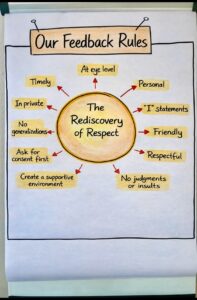
With a great deal of commitment, classic and unconventional training methods, she was able to sensitize the colleagues in our workshop “Team building through feedback”. For teachers, receiving personal feedback in a group of colleagues is an unusual situation. With her professional moderation and a great deal of sensitivity, she mastered this excellently and led the workshop to a "tangible" result in the form of feedback rules that we developed together with her. The result will accompany the colleagues in the department in their future work.
Dr. M. B., Engineer/Managing Director of a Company in the Aviation Industry
With her background in mediation and coaching and her skills as an intercultural trainer, she was able to guide the German-English team through the workshops. In linguistically very difficult situations and in heated discussions, she was able to contribute significantly to the success of the workshops through simultaneous interpreting. Ms. Kostadinowa impressed and inspired my colleagues and me with her engaging, people-oriented manner, her humor and her strong personality.
G. V., Dental Practice Manager
Both the team and my partner and I have come to know and appreciate Ms. Kostadinowa-Rohde's warm-hearted manner, her humor and her structured leadership. She asks smart questions, picks up when things get very emotional, shows ways forward when one or the other is stuck in a mental dead end, is always empathetic and patient and continuously gives appreciative and helpful feedback. We all felt strengthened and understood by working with her. Her working style has also deepened the understanding between us and promoted cohesion. My partner and I now have a strong and motivated team that we enjoy working with every day.
S. K., Coffee Import Company Manager
I was given lots of energy and positive tips and left each session with lots of feedback and inspiration. Ms. Kostadinowa-Rohde takes on the personal story - in her manager coaching sessions - and thus deals specifically with the individual professional situation. I always came away from a session feeling stronger and knowing that I could count on honest feedback from Ms. Kostadinowa-Rohde. Thank you for your great support in my day-to-day work!
A. S., Remedial Teacher, Assisted Individual Living for Mentally Ill People
I met a woman who touched me with her authenticity, sensitivity and high level of professionalism. In the team supervision sessions, Ms. Kostadinowa-Rohde ensures a balance between extroverted and introverted participants. I am particularly impressed by her sensitive attention to the words that are spoken and, above all, to the words that are not spoken. Recognizing the issues without judgment, with a clear focus on solutions, without losing the naturalness, I clearly name as an outstanding strength. I am grateful that Ms. Kostadinowa-Rohde makes the world more understanding, clearer, happier and lighter. I wish Mrs. Kostadinowa-Rohde much health, strength and joy to continue to bring her great work into the world.
T. S., Dental Practice Manager
I had a team coaching session with my practice team and Ms. Kostadinowa over several sessions. The reason for this was to gain understanding for my colleagues and to achieve better cooperation in a growing team. Even though the team was a little skeptical at first about what to expect, Ms. Kostadinowa quickly won everyone over. Through several exercises and team tasks, we were able to grow together better and address problems openly. Even though everything is a process and takes time, it was helpful and also very informative for me as a manager. I can only recommend it to any manager who wants to grow together with their team. The employees were also able to learn something new, whether for their work or how to deal better with conflicts in their private lives in future.
C. S., IT Company Executive
Ms. Kostadinowa supported us in a complex process very competently, sensitively and with a lot of patience and thus contributed significantly to team improvements on various levels. I can recommend you and your skills!
J. S., Head of Daycare Center
We worked as a team with Ms. Kostadinowa-Rohde and it cleared up a lot of things and brought them to the surface, so that we now have a much better team atmosphere. I would work with her again at any time.
F. M., Research Center Manager
Ms. Kostadinowa has been accompanying my team and me as a conflict moderator and management coach for several years - whether in times of crisis due to Corona or when changes in the team, change processes, etc. have led to tensions in the team. She works with us primarily with the entire team, but sometimes also in pairs or in individual sessions - both in person and online.
We are more than satisfied with her performance and look forward to further discussions with her. Thank you very much for your support.