
Intercultural Mediation in Berlin, Brandenburg, and Online
Understanding cultural differences. Resolving misunderstandings. Developing solutions.
- Are there conflicts between people from different cultures that are difficult to grasp or explain?
- Do you feel that misunderstandings arise even though everyone involved is working professionally and solution-oriented?
- Would you likeneutral support from someone who understands cultural differencesand can incorporate them into the resolution process?
Why Intercultural Mediation Is Important

Conflicts between people from different cultural backgrounds are often more complex than they appear at first glance.
What is said is interpreted differently.
What is meant is not always understood.
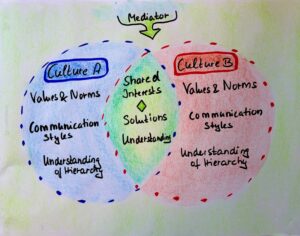
Different conceptions of hierarchy, communication, responsibility, or collaboration can cause discussions to stall, even though all parties involved want a solution.
Intercultural mediation creates a framework, in which these differences are made visible and understandable – without judgment or blame – with a genuine interest in the perspectives of all involved.
What Sets Intercultural Mediation Apart – The Principles
Intercultural mediation also follows clear fundamental principles: These are complemented by a central approach: intercultural sensitivity. This means that differences are not judged, but understood.
- Voluntary participation: All parties involved make a conscious decision to participate in the process.
- Impartiality: All perspectives are given equal consideration.
- Confidentiality: A safe space for open discussion is created.
Personal responsibility: Solutions emerge from the participants themselves.
How Intercultural Mediation Works – The Phases
The structure follows that of traditional mediation but is expanded to include an intercultural perspective. This structure helps not only to resolve the conflict but also to strengthen mutual understanding in a lasting way.
- Clarification of the Mandate and Framework:
Clarification of context, cultural backgrounds, and expectations. - Identifying issues:
Bringing all relevant points of conflict to light. - Understanding perspectives and cultural influences
What meanings, values, and expectations are at play in the background? - Developing solutions:
Developing solutions that are viable for all cultural perspectives. - Agreement and implementation in daily life:
Concrete agreements for cooperation.
Conclusion
Intercultural conflicts do not arise because something is going wrong, but because people are shaped differently. With the right guidance, they can lead to greater understanding, trust, and clarity.
Here’s how intercultural mediation can provide concrete support:
- Clarify misunderstandings between cultural contexts.
- Improve communication and collaboration.
- Highlight differing expectations.
- Strengthen trust among those involved.
- Develop sustainable solutions.
I support you with intercultural sensitivity, clarity, and the experience gained from many years as an international interpreter, along with a keen sense for what lies between the lines – which often makes all the difference.
Frequently asked questions about intercultural mediation in Berlin, Brandenburg, and online
1. What is intercultural mediation?
Intercultural mediation is a structured and confidential process in which I support you in resolving conflicts between people from different cultural backgrounds in a respectful and constructive manner, with a genuine understanding of cultural differences.
2. When is intercultural mediation appropriate?
Whenever cultural differences, varying communication styles, or differing expectations strain collaboration or lead to misunderstandings.
3. How does it differ from traditional mediation?
Here, cultural influences, values, and communication patterns are consciously incorporated into the process and reflected upon together.
4. Who is intercultural mediation suitable for?
For international companies, executives, teams with diverse backgrounds, and individuals who work or live in an intercultural environment.
5. What issues commonly arise?
Communication problems, misunderstandings, differing expectations, role models, and values – often, there is much more behind a seemingly minor conflict.
6. Is intercultural mediation also possible online?
Yes, and it is often particularly well-suited when the parties involved are in different locations. Online mediation is flexible and just as effective as a face-to-face meeting.
7. What role does language play in this?
A central one. It’s not just about what is said, but also about the meaning behind it. What is considered direct and respectful in one culture can quickly come across as rude or overly familiar in another. It is precisely these misunderstandings that I bring to light and make discussable during the mediation process.
8. How long does intercultural mediation take?
Depending on the issue and its complexity, it usually takes several sessions. We will discuss in advance what makes sense for your situation.
9. Do all parties involved have to participate?
Yes, because mediation is based on voluntary participation and the active involvement of all parties to the conflict. Only then can genuine resolution be achieved.
10. What is the goal of mediation?
A sustainable, mutually agreed-upon solution and a deeper mutual understanding that extends beyond the conflict.
M. V., Manager and Dentist in a Dental Practice
Ms. Kostadinowa-Rohde very quickly succeeded in strengthening us as a management team in structured coaching sessions and her professional feedback helped us a lot in the further development of our management style, the structure in our practice and also in holding team meetings to discuss current issues in order to avoid new conflicts.
Dr. P. B., Lecturer and Head of Department at a Berlin University
With a great deal of commitment, classic and unconventional training methods, she was able to sensitize the colleagues in our workshop “Team building through feedback”. For teachers, receiving personal feedback in a group of colleagues is an unusual situation. With her professional moderation and a great deal of sensitivity, she mastered this excellently and led the workshop to a "tangible" result in the form of feedback rules that we developed together with her. The result will accompany the colleagues in the department in their future work.
Dr. M. B., Engineer/Managing Director of a Company in the Aviation Industry
With her background in mediation and coaching and her skills as an intercultural trainer, she was able to guide the German-English team through the workshops. In linguistically very difficult situations and in heated discussions, she was able to contribute significantly to the success of the workshops through simultaneous interpreting. Ms. Kostadinowa impressed and inspired my colleagues and me with her engaging, people-oriented manner, her humor and her strong personality.
G. V., Dental Practice Manager
Both the team and my partner and I have come to know and appreciate Ms. Kostadinowa-Rohde's warm-hearted manner, her humor and her structured leadership. She asks smart questions, picks up when things get very emotional, shows ways forward when one or the other is stuck in a mental dead end, is always empathetic and patient and continuously gives appreciative and helpful feedback. We all felt strengthened and understood by working with her. Her working style has also deepened the understanding between us and promoted cohesion. My partner and I now have a strong and motivated team that we enjoy working with every day.
S. K., Coffee Import Company Manager
I was given lots of energy and positive tips and left each session with lots of feedback and inspiration. Ms. Kostadinowa-Rohde takes on the personal story - in her manager coaching sessions - and thus deals specifically with the individual professional situation. I always came away from a session feeling stronger and knowing that I could count on honest feedback from Ms. Kostadinowa-Rohde. Thank you for your great support in my day-to-day work!
A. S., Remedial Teacher, Assisted Individual Living for Mentally Ill People
I met a woman who touched me with her authenticity, sensitivity and high level of professionalism. In the team supervision sessions, Ms. Kostadinowa-Rohde ensures a balance between extroverted and introverted participants. I am particularly impressed by her sensitive attention to the words that are spoken and, above all, to the words that are not spoken. Recognizing the issues without judgment, with a clear focus on solutions, without losing the naturalness, I clearly name as an outstanding strength. I am grateful that Ms. Kostadinowa-Rohde makes the world more understanding, clearer, happier and lighter. I wish Mrs. Kostadinowa-Rohde much health, strength and joy to continue to bring her great work into the world.
T. S., Dental Practice Manager
I had a team coaching session with my practice team and Ms. Kostadinowa over several sessions. The reason for this was to gain understanding for my colleagues and to achieve better cooperation in a growing team. Even though the team was a little skeptical at first about what to expect, Ms. Kostadinowa quickly won everyone over. Through several exercises and team tasks, we were able to grow together better and address problems openly. Even though everything is a process and takes time, it was helpful and also very informative for me as a manager. I can only recommend it to any manager who wants to grow together with their team. The employees were also able to learn something new, whether for their work or how to deal better with conflicts in their private lives in future.
C. S., IT Company Executive
Ms. Kostadinowa supported us in a complex process very competently, sensitively and with a lot of patience and thus contributed significantly to team improvements on various levels. I can recommend you and your skills!
J. S., Head of Daycare Center
We worked as a team with Ms. Kostadinowa-Rohde and it cleared up a lot of things and brought them to the surface, so that we now have a much better team atmosphere. I would work with her again at any time.
F. M., Research Center Manager
Ms. Kostadinowa has been accompanying my team and me as a conflict moderator and management coach for several years - whether in times of crisis due to Corona or when changes in the team, change processes, etc. have led to tensions in the team. She works with us primarily with the entire team, but sometimes also in pairs or in individual sessions - both in person and online.
We are more than satisfied with her performance and look forward to further discussions with her. Thank you very much for your support.